Yeshua Ha-Nozri
Yeshua Ha-Nozri, a vagrant philosopher from the town of Gamala, is the figure around whom the deepest moral questions of The Master and Margarita revolve. Brought before Pontius Pilate in Yershalaim on the morning of the fourteenth of Nisan, he is accused of inciting the destruction of the temple. His trial, crucifixion, and the consequences that ripple through time constitute the novel's historical core, a story that is told, dreamed, and written by different characters, yet retains a unified, haunting power. Yeshua is not a divine figure in the traditional sense; he is a man of about twenty-seven, alone in the world, who believes that there are no evil people and that all authority is violence. His gentle, unshakable conviction in a coming kingdom of truth and justice sets him against the Roman procurator and the machinery of imperial power, and his fate becomes the measure of Pilate's—and the master's—cowardice and guilt.
Identity and Background
Yeshua Ha-Nozri is introduced as a prisoner with bound hands, dressed in a torn light-blue chiton, his face bearing a large bruise and a cut caked with blood. He claims not to know his parents, stating that his father was a Syrian, and that he has no permanent home, traveling from town to town. He is literate, speaking Aramaic and Greek, and has a single companion, Matthew Levi, a former tax collector who abandoned his money to follow him. Yeshua's origins are humble and obscure; he comes from Gamala, a town in the north, and his only possession is his teaching. He is a figure of radical simplicity, possessing no family, no fixed abode, and no desire for power or wealth.
The Trial Before Pilate
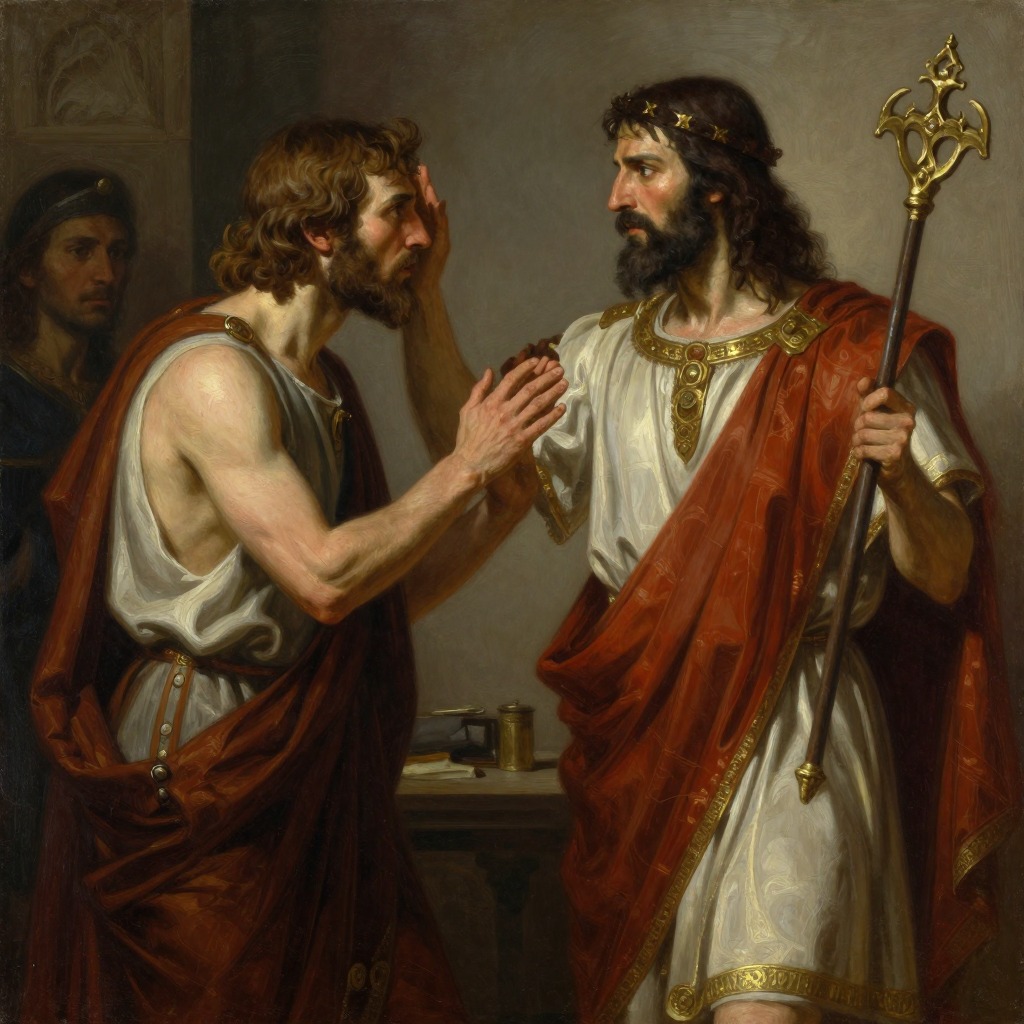
The interrogation by Pontius Pilate is the pivotal scene for Yeshua. Suffering from a debilitating hemicrania, Pilate initially treats him with contempt, ordering the centurion Mark Ratslayer to beat him for addressing the procurator as "good man." Yet Yeshua's response to Pilate's question "What is truth?" transforms the encounter. He tells Pilate that the truth is, first of all, that his head aches and that he is thinking of death. He diagnoses Pilate's isolation and loss of faith in people, advising him to take a walk in the gardens on the Mount of Olives. This uncanny perception, combined with his refusal to lie about his teachings, forces Pilate to recognize his innocence. Yeshua admits to speaking about the temple of the old faith falling and a new temple of truth being built, and to telling Judas of Kiriath that all authority is violence over people and that a time will come when there will be no need for any authority. Despite Pilate's desire to save him, the revelation of Yeshua's words about Caesar—a crime of lese-majesty—makes his condemnation inevitable. Pilate confirms the death sentence, but his anguish is immediate and permanent.
The Crucifixion and Death
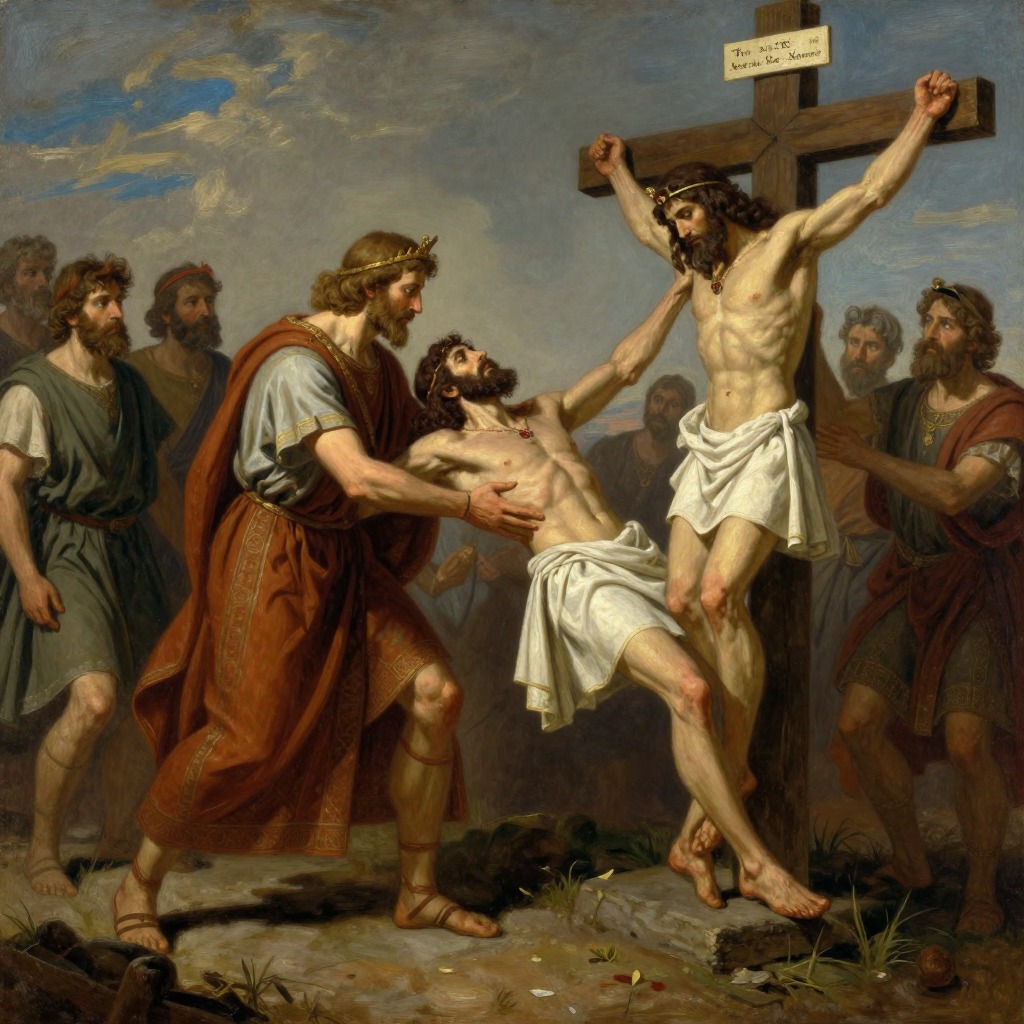
The execution on Bald Mountain is a scene of prolonged, agonizing suffering. Yeshua is crucified alongside two robbers, Dysmas and Gestas. He is more fortunate than the others, falling into oblivion early, his face covered by flies and horseflies. In the fifth hour, an executioner, following orders, offers him a sponge soaked in water on the tip of a spear. Yeshua drinks, then begs the executioner to give a drink to Dysmas. The executioner then pierces Yeshua's heart with the spear, whispering, "Praise the magnanimous hegemon." Yeshua's last word is "Hegemon." His body is taken down from the post by Matthew Levi, who cuts the ropes and carries him away in the storm. The death is not a triumphant sacrifice but a squalid, brutal end, witnessed only by a few soldiers, the executioners, and a single, despairing disciple.
Relationships and Conflict
Yeshua's primary relationship is with Pilate, a connection forged in a single, interrupted dialogue. He sees Pilate not as a monster but as a closed-off, unhappy man whose life is impoverished by his inability to trust. His relationship with Matthew Levi is one of devoted, if flawed, discipleship; Levi's attempt to save him by stealing a bread knife fails, and his subsequent rage at God underscores the human inability to accept Yeshua's fate. The betrayal by Judas of Kiriath, a young man who invited Yeshua to his home and then reported his words to the authorities, is presented as a trap, but Yeshua feels only pity for him, foreseeing that Judas will come to grief. Yeshua's conflict is not with individuals but with the system of authority itself, which he condemns as violence, and with the cowardice that prevents even a sympathetic man like Pilate from acting on the truth.
Thematic Significance and Afterlife
Yeshua's fate is the novel's moral fulcrum. His statement that "cowardice is the most terrible of vices" is repeated throughout the book and directly applies to Pilate, who lacks the courage to follow his own judgment. Yeshua does not return in glory; instead, he sends Matthew Levi to Woland to ask for "peace" for the master, not "the light." The master's novel about Pilate and Yeshua is the work that connects the historical and contemporary plots, and its survival—"Manuscripts don't burn"—is a testament to the enduring power of the truth Yeshua represents. He is the figure who, by his very existence, exposes the lie of imposed reality and offers the possibility of forgiveness, even for a man who has sat like a stone for two thousand years, waiting to continue their conversation.